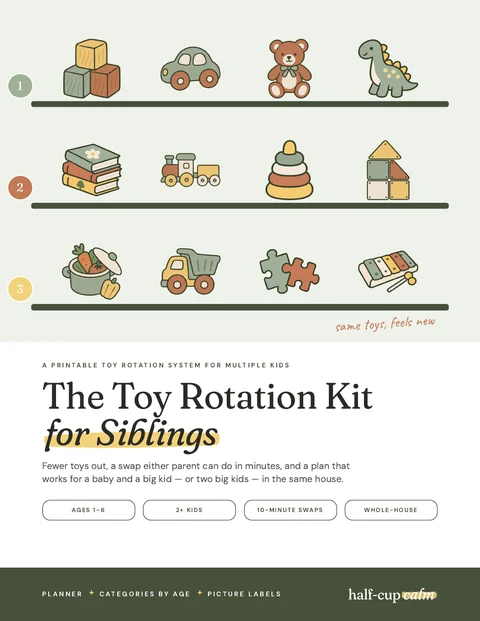
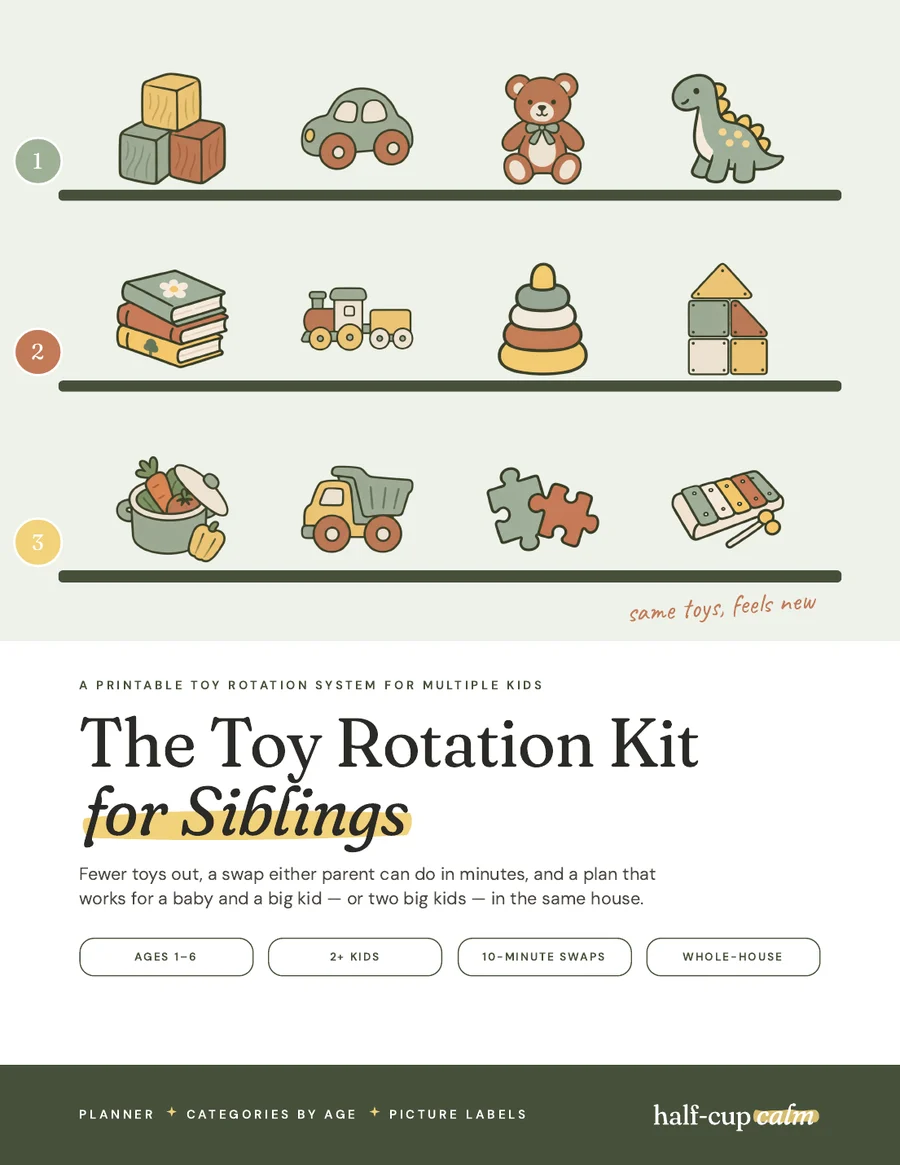
The Toy Rotation Kit for Siblings
Fewer toys out and a ten-minute swap every two weeks — one system for a baby and a big kid in the same house.Fewer toys out, a ten-minute swap — built for a baby and a big kid in the same house.
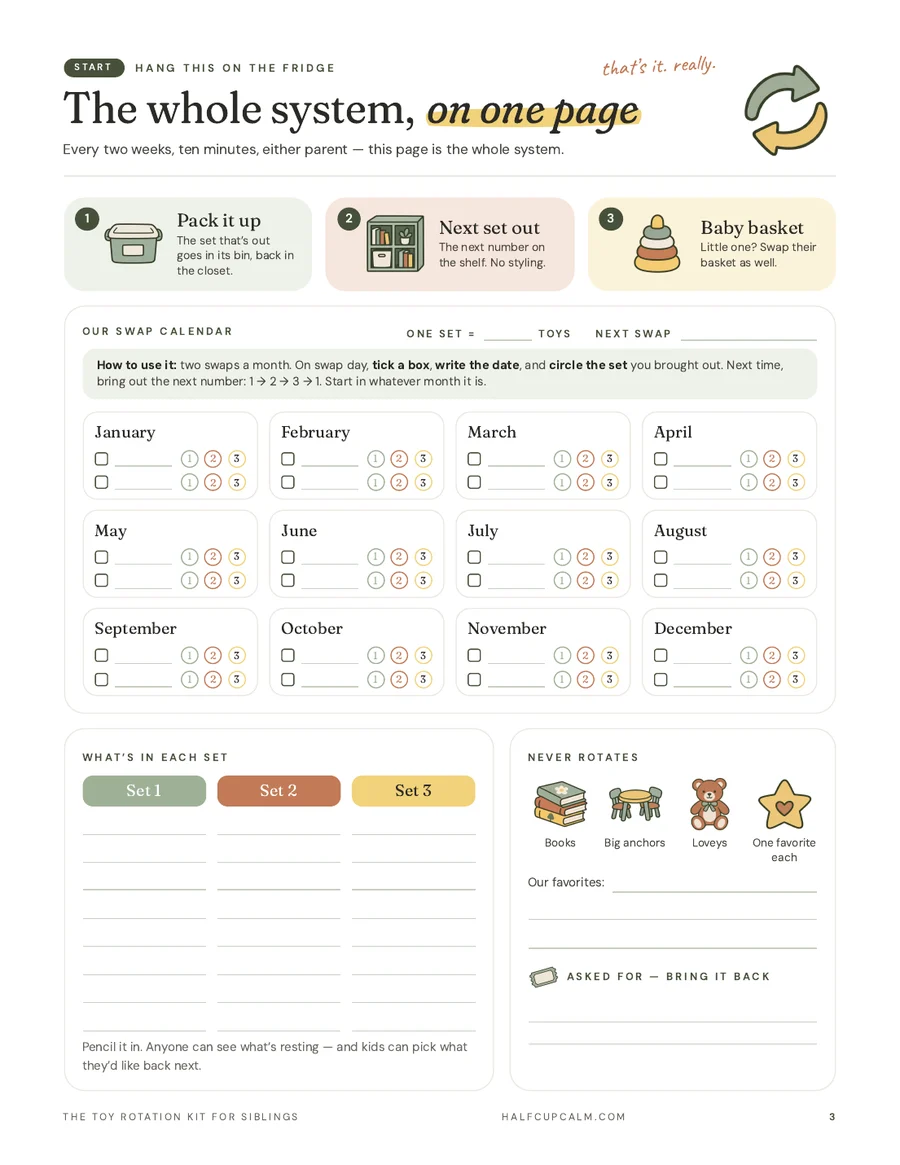
- The whole system on one fridge page
- Set planner, sibling zones & 45 picture labels
- Kid pages: sharing poster, clean-up chart, tickets
Instant download · Letter, A4 & printer-friendly PDFs · editable labels in Canva
 Made by Kayla, a working mom of two
It’s not that they need more toys.
It’s that everything is out at once, and with two kids at two ages, every toy is either too young, too old, or somebody else’s. Toy rotation fixes the first problem. This kit is built for the second one.
- Every bin gets dumped, and nothing gets played with
- “I’m bored” — in a room with sixty toys out
- Cleanup ends in tears (theirs or yours)
- The same three toys get fought over every day
- New gifts have nowhere to land
Three sets. Ten minutes. Every two weeks.
That’s the whole system. Everything else in the kit is there when you want more, and clearly marked as optional when you don’t.
- 1
Declutter first
Broken, outgrown and never-touched toys leave before anything gets sorted. Hand-me-downs go in a “save for the little one” bin.
- 2
Build three sets
Split the keepers into three bins, a little of everything in each. One set is out; two rest in the closet.
- 3
Swap every two weeks
Pack up the set that’s out, bring out the next. Ten minutes. Either parent can do it — the fridge page says what’s next.
Most toy rotation guides assume one child.
One number for the whole house
Add each kid’s toys-out number and count shared toys once. No separate systems per child.
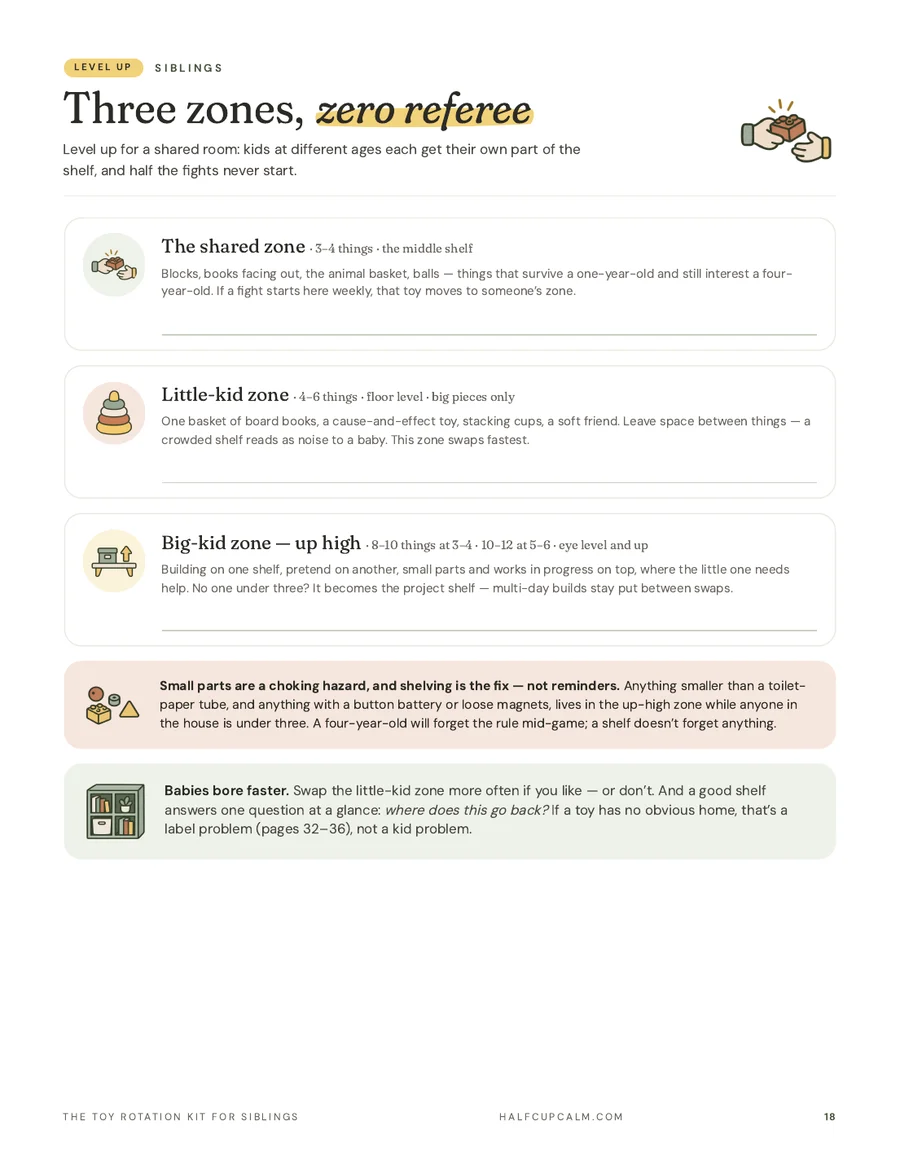
Shelves that stop the fights
A shared zone, a floor-level zone for the baby, and an up-high zone for small parts and the big kid’s builds.
“Special toys” that are actually theirs
A poster and name labels so each kid has a few things nobody else touches — and a script for when someone cries.
Hand-me-downs that come back as “new”
What the big kid outgrows waits in its own bin and re-enters rotation for the little one later.
38 pages, made to fit your family.
Start with the fridge page and the set planner, then add what your house needs: picture labels for little ones, shared zones for siblings, kid pages for the big kid. Every page is tagged Start, Level up, Optional or Printable, so your next step is always clear.
The one-page system
A fridge page with the three steps, a month-by-month swap calendar and what’s in each set.
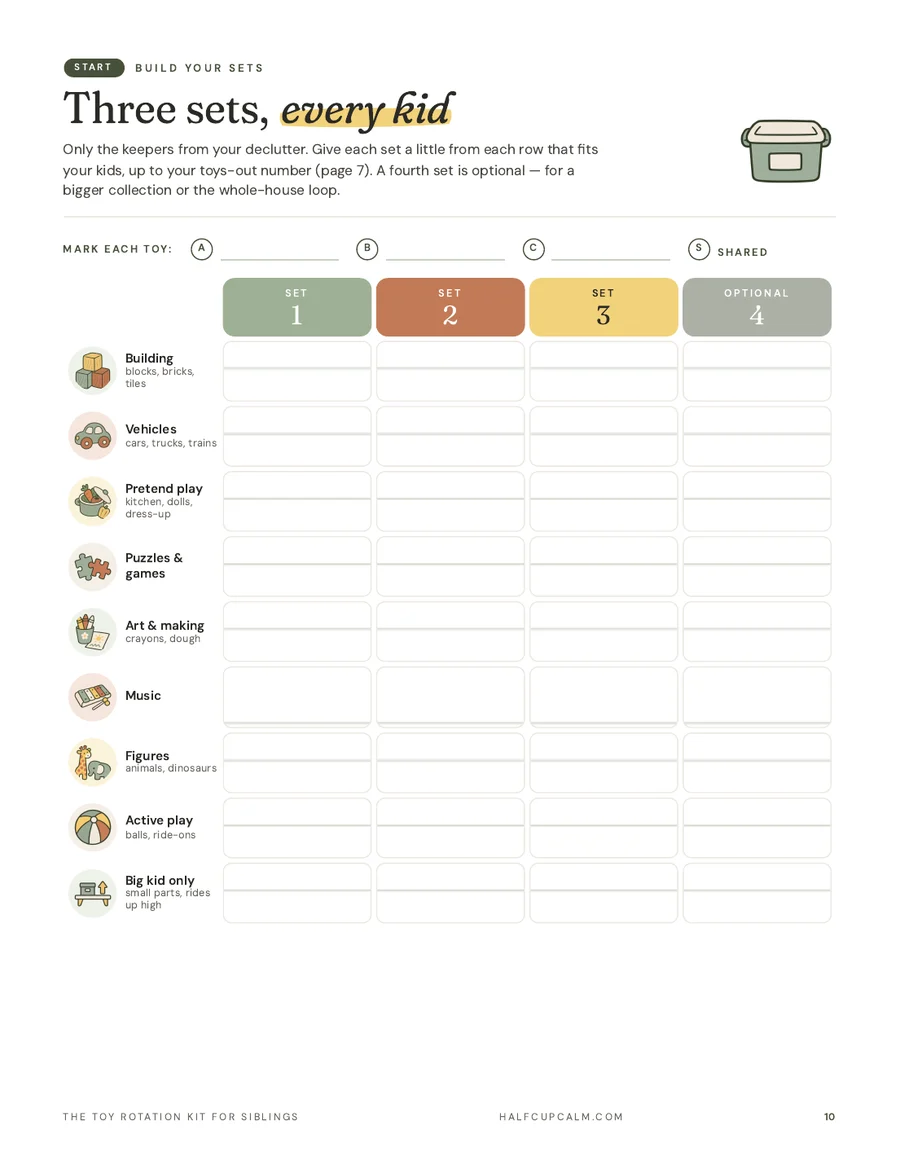
Set planner
Plan three sets by category, with a line for each kid.
Sibling zones
How to split one shelf between a baby and a big kid.
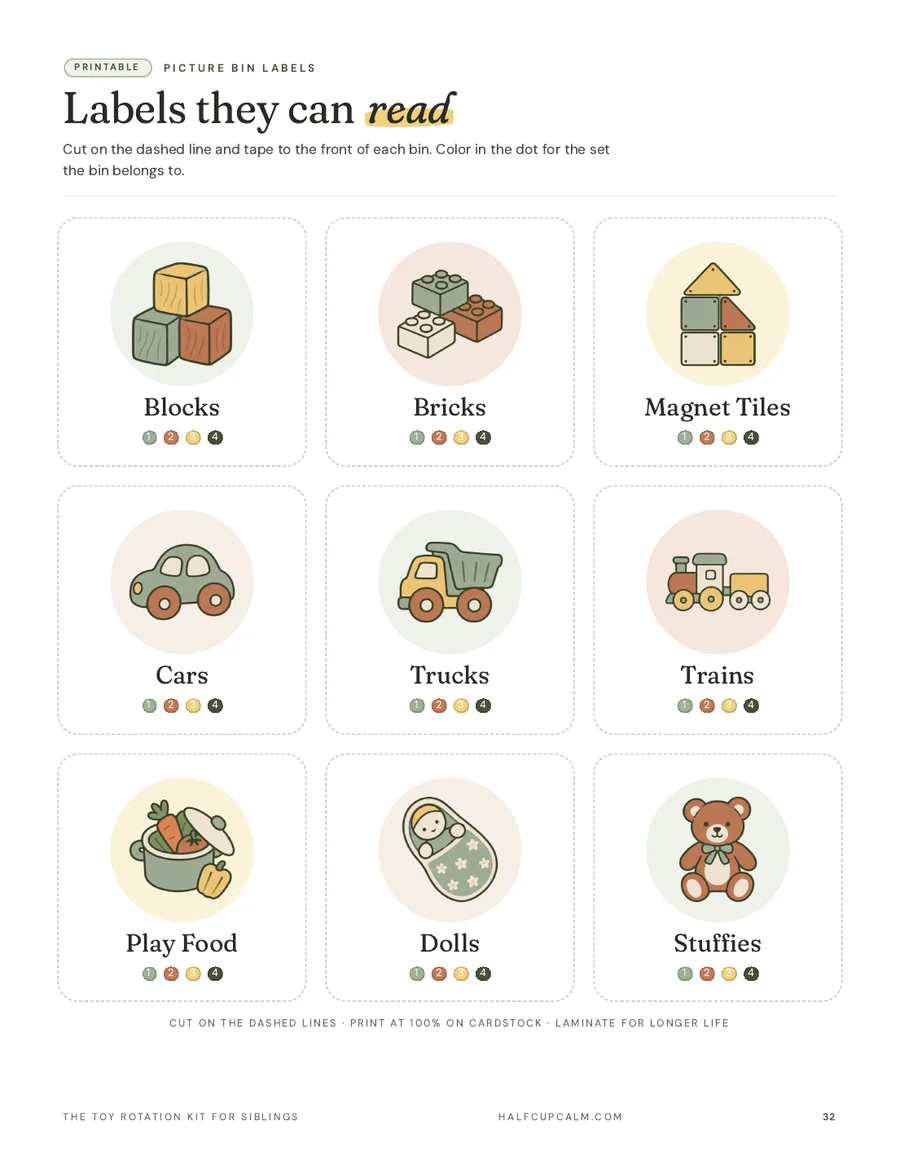
45 picture labels
Kids can read them before they can read. Plus 9 blank ones for your own toys.
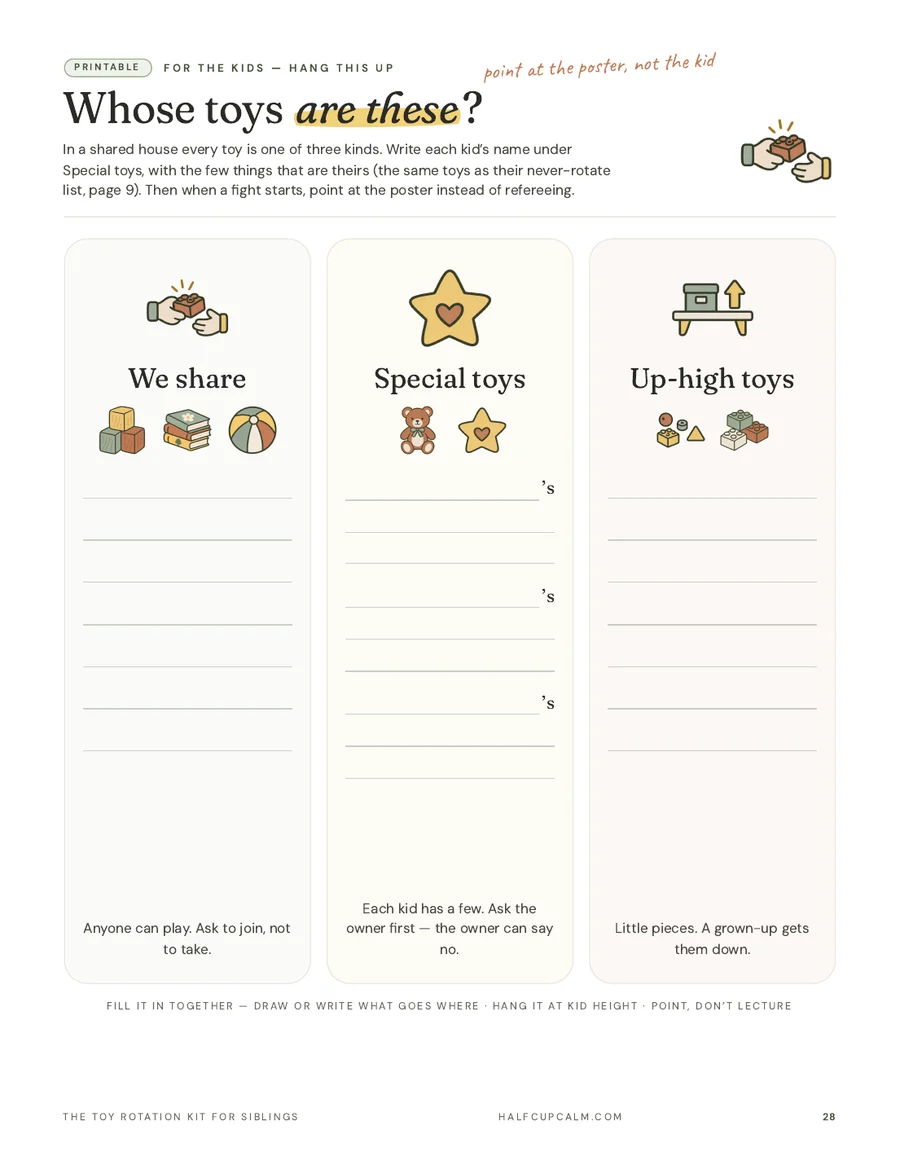
Kid pages
A sharing poster, a clean-up chart, a countdown and bring-it-back tickets.
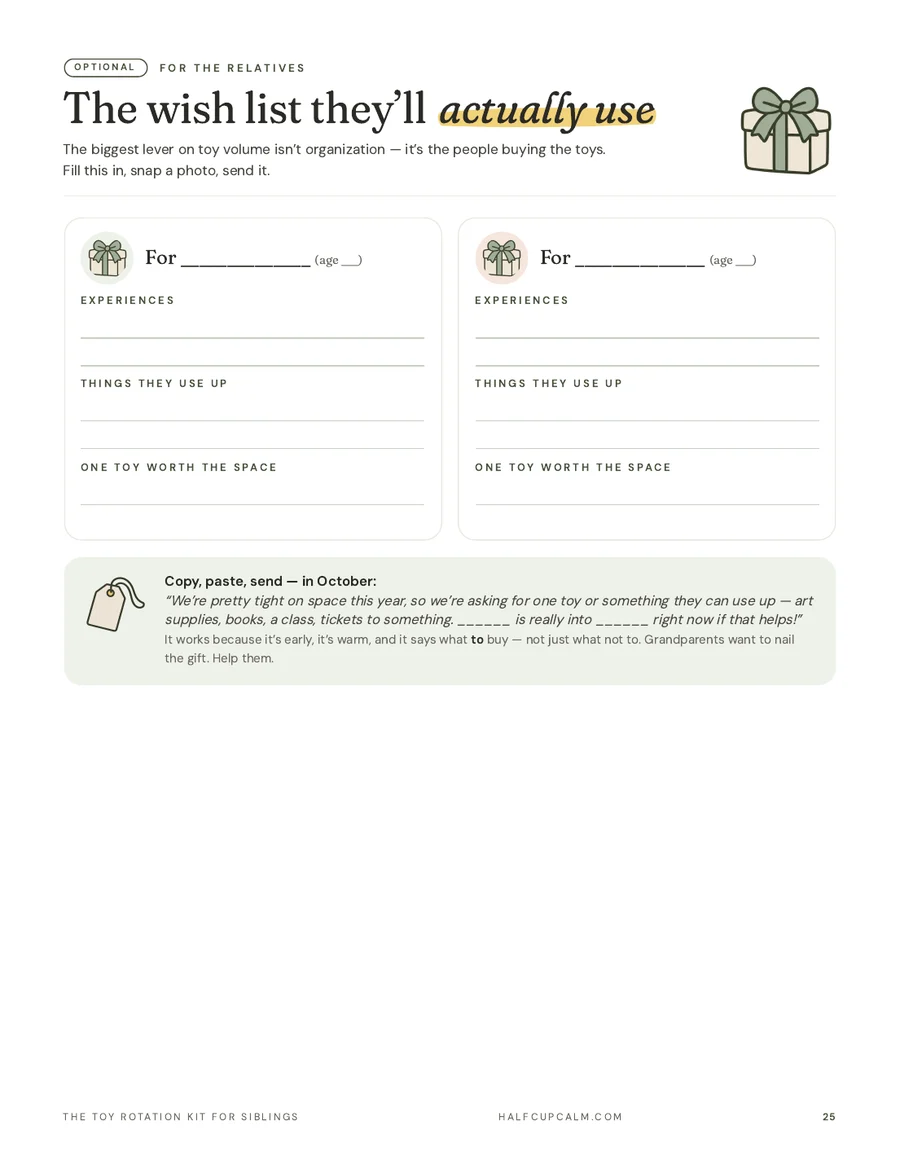
A wish list for relatives
Plus a copy-paste note that asks for fewer, better gifts — before they shop.
Also inside: the 20-minute version · how many toys to leave out by age · a declutter guide · what never rotates · scripts for each age · the whole-house room-to-room loop · a small-space version · troubleshooting · a gift-season plan · room cards for sitters · swap log · one-in-one-out tracker.

We have a four-year-old, a one-year-old, and toys in three rooms. Every toy rotation guide I found was built for one kid and a beautifully styled Montessori shelf. We don’t have that shelf. What worked for us was simpler: fewer toys out, a few sets that take turns, and a system either of us can run without asking the other where anything goes.
This kit is that system, written down.
— Kayla
Good to know
What ages is it for?
Roughly 1 to 6. The toy counts and categories run from 12 months up, and there are setups for a baby and a preschooler, two kids close in age, a big kid and a toddler, and three or more.
Do I need to buy bins or a new shelf?
No. Three bins or boxes you already own and one closet (or under the bed) is the whole thing. There’s a small-space version for apartments.
How long does setup take?
A nap time or two for the full version. If tonight is all you have, there’s a 20-minute version that needs nothing printed.
What do I get, and how?
Right after checkout you get the download on screen and in your receipt email: US Letter, A4, and a printer-friendly black-and-white PDF. Plus a Canva template of the 9 pages worth personalizing (all the labels, the fridge page, the set planner and the room cards) so you can type names and add your own photos. The rest of the kit is for reading or writing on by hand, so it’s PDF-only. A free Canva account works.
Does toy rotation work with multiple kids?
Yes, but not by running a separate rotation per child. Add each kid’s toys-out range, count the toys they both use once, and give each age its own shelf zone: floor level for the baby, up high for small parts and the big kid’s builds.
How many toys should be out at once?
Starting points from the kit: 4–6 for 12–18 months, 6–8 up to about 2½, 8–10 at 3–4 and 10–12 at 5–6. Dumping everything means too many are out; wandering off means too few. With siblings, don’t multiply by kids.
Is it only for siblings?
It works for one child too. It’s built for the harder case — kids at different ages sharing the same toys and the same rooms.
Can I print it more than once?
Yes, for your own home, as often as you like. Please don’t share or resell the file.
Something else? Email hello@halfcupcalm.com.
Calmer floors, longer play.
Same toys, feels new. Ten minutes every two weeks.
Get the kit $7Instant download · Letter, A4 & printer-friendly PDFs · editable labels in Canva