Reset the Playroom Before the Holidays (A 3-Weekend Plan)
Every December I do the same thing. The gifts get opened, the boxes get flattened, and then I stand in the playroom holding a new Monster Jam smash arena with all the lights and sounds with absolutely nowhere to put it. So it goes on the floor. And it stays on the floor, because the floor is now the only available surface, and by January the room has quietly absorbed a whole new layer.
The fix is boring and it works: clear the space before the toys arrive, not after.

The catch is that this only works if you do it early. In December you’re out of time and out of patience, and every decision about what to give away turns into a negotiation with a kid who is, understandably, thinking about presents. In late September and October, nobody is thinking about presents. That’s the window.
Here’s the version I do now. It’s three short sessions across three weekends, not a marathon.
If the room is already overfull before you start, the underlying problem is capacity rather than organization — I wrote about that in more detail in 10 Simple Organization Ideas for Small Playrooms That Actually Work.
Weekend one: count the surfaces, not the toys
Don’t start by sorting. Start by figuring out how much room you actually have.
Walk in and count the places a toy can legitimately live: shelves, bins, the closet floor, under the bed. Write the number down. That’s your capacity, and it does not change just because December happens.
Then ask the real question: how much of that capacity is free right now?
If the answer is “none,” you already know what the rest of this post is going to say. Every new toy that comes in has to displace something, and if you don’t choose what gets displaced, the floor chooses for you.
Aim to have roughly a quarter of your storage empty before the holidays. That sounds like a lot. It’s the difference between putting gifts away in ten minutes and living with a floor pile until spring.
Time: fifteen minutes. This is the whole session.
Weekend two: the outbound pass
Now you sort — but only into three destinations, and you decide where each one physically goes before you start.
Broken or missing pieces. No decision required. This is the fastest and most satisfying pile, and it’s usually bigger than you expect.
Outgrown. Things your kids have aged past. Genuinely easy once you look, because we tend to keep them out of sentiment rather than use.
Not touched in months. The hard one. Not “doesn’t get played with today” — actually think back. If you can’t remember the last time it came out, it goes.
Two rules that make this stick:
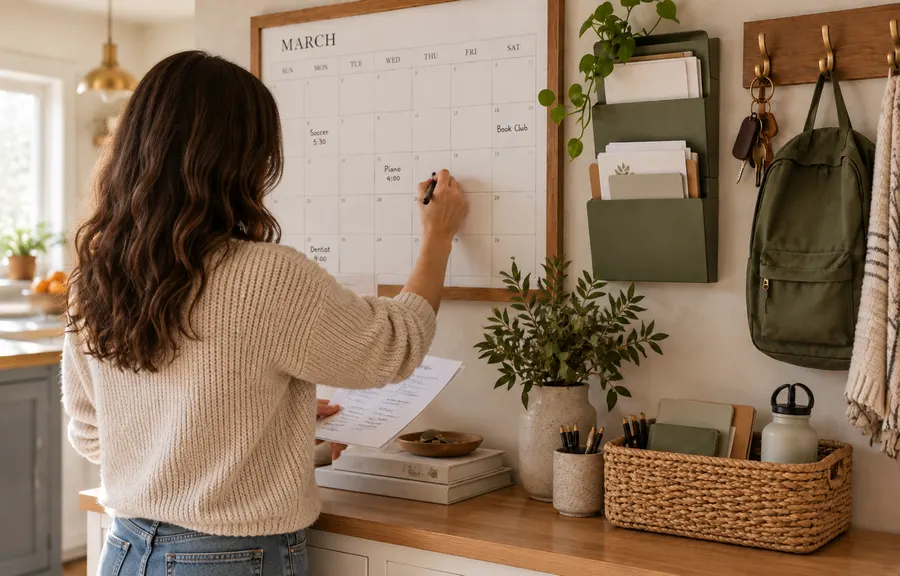
The box has to leave the house within a week. A donate box in the garage is not decluttering; it’s relocation. Put the drop-off on the calendar the same day you fill the box.
Do the first pass without the kids. I know that’s not the popular advice. But a four-year-old asked to choose between sixty toys will choose all sixty, and you’ll both end up frustrated. Do the obvious removals alone, then bring them in for the genuinely ambiguous stuff. That’s a much shorter, much calmer conversation.
Time: 45 minutes if you don’t reorganize while you go. Which you will want to do. Don’t.
Weekend three: decide where the gifts land
This is the step nobody does, and it’s the one that actually prevents the December floor pile.
Pick the specific shelf or bin that will hold new toys. Empty it now. Leave it empty.
It looks wasteful for two months. Then the gifts arrive, and there is a place to put them, and you don’t spend the last week of December performing emergency triage in a room full of wrapping paper.
While you’re at it, decide the one-in-one-out rule in advance and say it out loud to your kids now, in September, when it’s abstract and nobody is attached to anything. Something like: when new toys come, we find some to pass on to kids who need them. Doing this early means it isn’t a rule you invented on Christmas morning to solve a problem.
Time: twenty minutes.
The part that helps most: talk to the relatives
The single biggest lever on holiday toy volume isn’t organization. It’s the people buying the toys.
Most grandparents genuinely want to know what’s useful. What they don’t want is to feel managed. A short, specific, warm ask lands much better than a policy:
“We’re pretty tight on space this year, so we’re asking for one toy or something they can use up — art supplies, books, a class, tickets to something. Rhett’s really into the aquarium and sea creatures right now if that helps.”
Two things make this work: it’s early enough that they haven’t bought anything yet, and it names something specific to buy instead of only what not to buy. Send it in October. Once the shopping starts, the conversation is over.
What I stopped doing
Sorting into categories while I decluttered. Two jobs at once means neither one finishes. Get things out of the room first. Organize what’s left in January if you still want to.
Buying storage to solve the problem. More bins raise capacity, which means the room holds more, which means the mess just gets tidier-looking without getting smaller.
Doing it all in one Saturday. The reason my earlier attempts failed wasn’t the method. It was scheduling a four-hour project into a life that doesn’t have four free hours in it.
If January comes and you do want to organize what’s left, rotation is how we handle it: most toys rest in the closet, and a few take turns coming out.
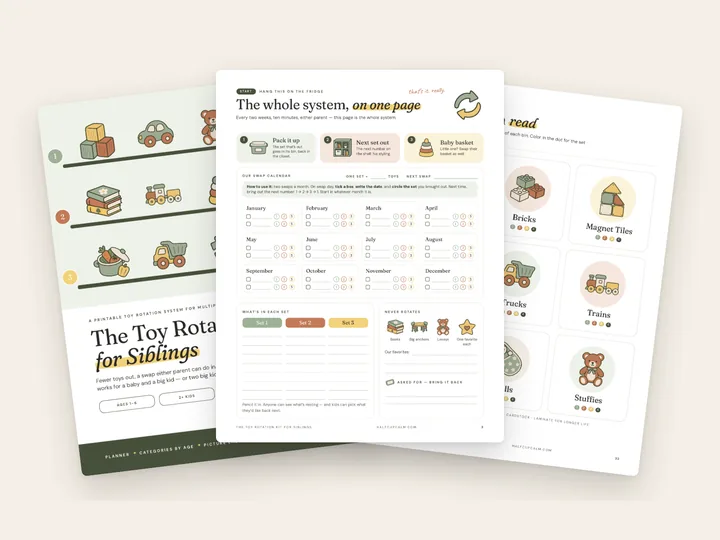
The Toy Rotation Kit for Siblings
A printable version of how we do it: declutter first, split what’s left into three sets, swap every two weeks. One plan for a baby and a big kid.
Get the kit $7The timeline, if you want it plain
- Late September: count your surfaces. Fifteen minutes.
- Early October: the outbound pass, and the drop-off on the calendar.
- Mid October: send the note to relatives.
- Late October: empty the landing shelf and leave it empty.
- December: put things away in ten minutes, like a person who planned ahead.
I’ll be straight with you: I didn’t do any of this last year. I meant to. Then September turned into November the way it does, and I spent the week after Christmas sitting on the playroom floor at 10 pm sorting toys into piles while everyone else slept, which is exactly the thing this post exists to prevent.
So this year I’m writing it down in September instead of promising myself I’ll remember. Fifteen minutes this weekend. That’s the whole first step. If you want to do it alongside me, that’s genuinely easier than doing it alone.